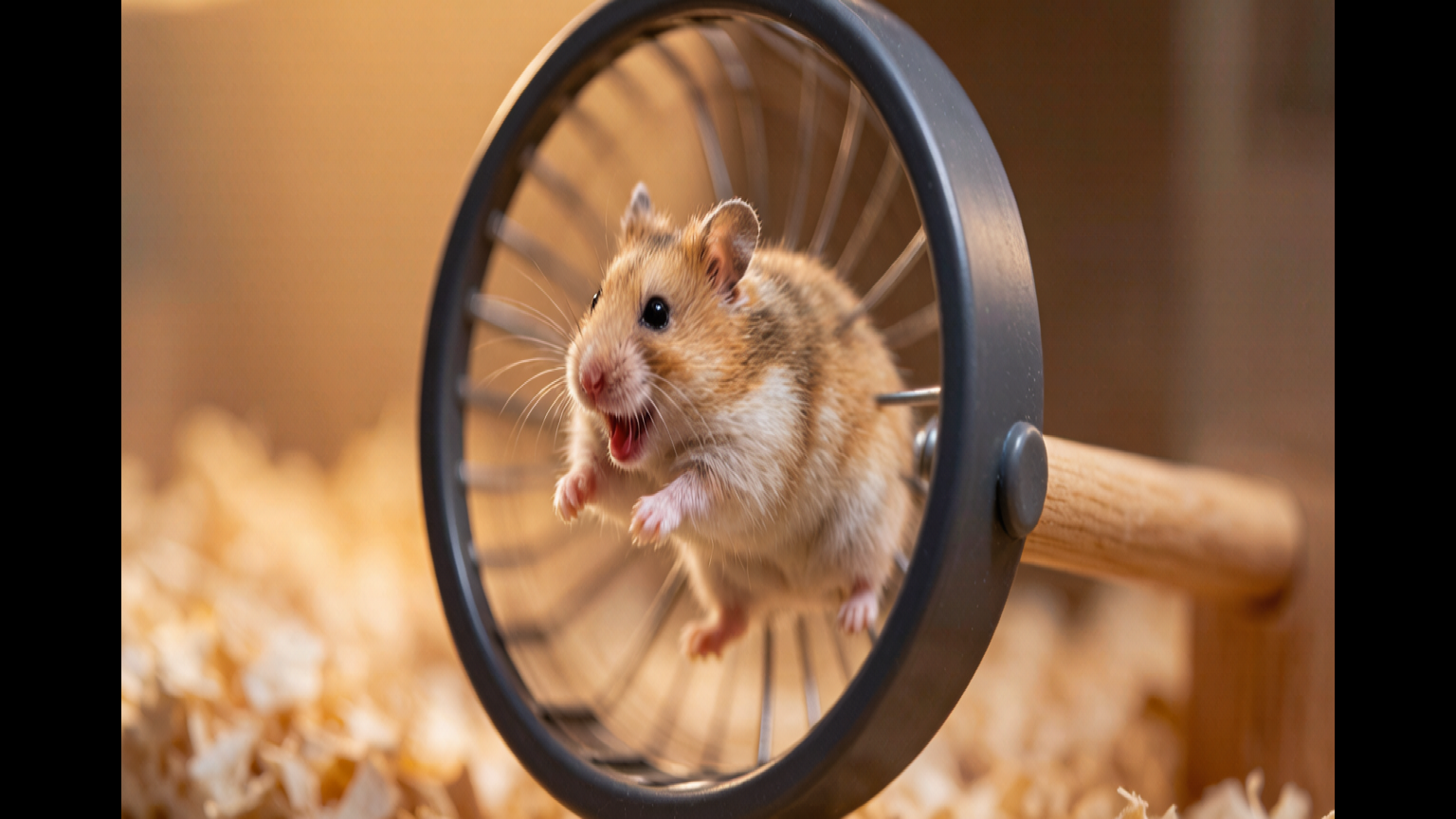
Few pet behaviors are as iconic — or as misunderstood — as a hamster running for hours on a wheel. The average hamster runs 5-9 kilometers (3-5.5 miles) per night on their wheel. This isn’t neurotic behavior; it’s the expression of one of the most powerful biological drives in the animal kingdom.
The Evolutionary Programming Behind the Wheel
In the wild, hamsters are crepuscular-nocturnal foragers covering enormous distances to locate scattered, unpredictable food resources. Their bodies and brains evolved for this marathon lifestyle — their metabolism, spatial memory, and circadian rhythms are all calibrated for nightly marathon foraging. When we place a hamster in a cage with food in a bowl two inches away, the biological drive to run doesn’t disappear — it gets redirected onto the wheel.
Remarkably, studies using wheels in the wild (placed in natural habitats) show that wild mice and rats will voluntarily run on wheels for hours — suggesting wheel-running is intrinsically rewarding, not merely a stress response to captivity. The neurological reward pathways activated by running are the same ones triggered by food and social interaction.
Wheel Requirements for Health
Size is Non-Negotiable: The wheel must be large enough that the hamster’s back remains completely straight while running. A curved spine during running causes permanent spinal deformities and chronic pain. Minimum diameter: 8 inches (20 cm) for dwarf species, 11-12 inches (28-30 cm) for Syrians. Solid Surface Only: Wire or mesh wheels cause bumblefoot (painful foot sores), broken toes, and trapped limbs. The running surface must be solid plastic or wood. Silent Operation: Ball-bearing mechanisms provide the quietest operation — critical since your hamster will run while you sleep.
Signs of Problem Wheel Behavior
While wheel running is normal, certain patterns indicate welfare problems: running exclusively during daylight hours (signals that the hamster doesn’t feel safe running at night), flipping over repeatedly or being thrown from the wheel (wheel too small or fast), and obsessive running to the exclusion of eating and drinking (indicates a barren environment with nothing else to do — add deep bedding, chew toys, scatter feeding, and a sand bath).