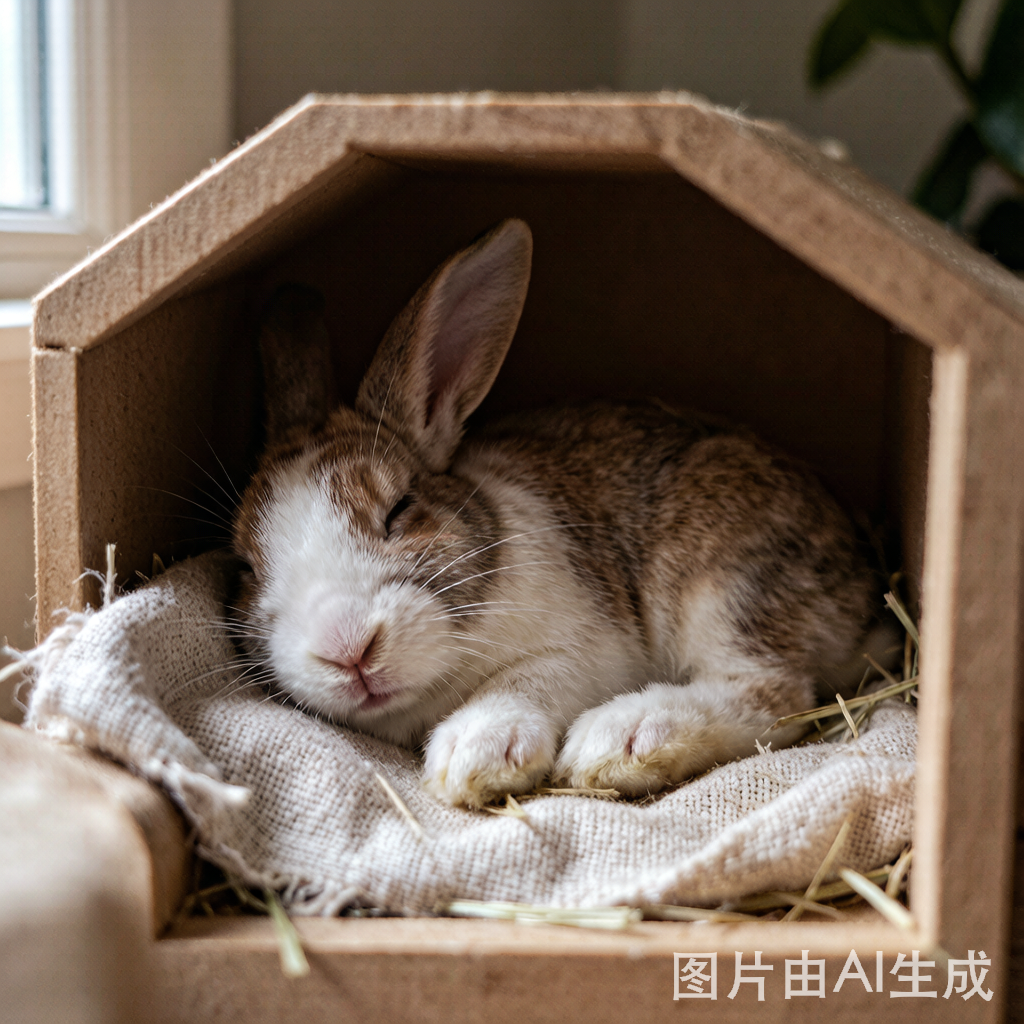
If you have ever tiptoed past your rabbit’s enclosure at 3 a.m. for a midnight snack and found them wide awake, nose twitching, and energetically rearranging their hay rack, you have encountered one of the most misunderstood aspects of rabbit behavior: they aren’t “night animals” in the way most people think. Rabbits are crepuscular — most active at dawn and dusk — and their sleep patterns are strikingly different from both humans (who sleep in one long block) and truly nocturnal animals (who are active all night). Understanding how, when, and how much rabbits sleep is essential not just for your own rest (yes, a thumping rabbit at 5 a.m. is a real problem), but for ensuring your rabbit gets the quality rest they need to stay healthy.
Sleep in rabbits is a fascinating and sometimes counterintuitive subject. They can sleep with their eyes open. They can doze in a seated position. They can enter deep sleep while flopped on their side in a position that looks disturbingly like death. And they can be sound asleep one moment and exploding into a panic over a dropped spoon three seconds later. In this guide, we’ll explore rabbit sleep science, how much sleep they actually need, how to tell if your rabbit is resting properly, and how to create a sleeping environment that works for both of you.
Are Rabbits Nocturnal, Diurnal, or Something Else?
Let’s clear up the confusion right away. Rabbits are crepuscular, meaning they are most active during the low-light hours of dawn and dusk. This behavior is deeply rooted in their evolution as prey animals. In the wild, being active at dawn and dusk allows rabbits to forage when visibility is low enough to offer some protection from predators, but not so dark as to make movement impossible. The harsh midday sun is for resting in a burrow; the deep midnight hours are for staying alert in the burrow.
In a domestic setting, this means your rabbit is likely to have two main activity peaks: one in the early morning (5–7 a.m.) and one in the early evening (6–9 p.m.). Between these peaks, they rest — but not necessarily in one long, uninterrupted block.
“My rabbit, Mochi, has a predictable schedule. She wakes up around 6 a.m., does a burst of zoomies and binkies for about 30 minutes, then settles in for a long morning nap. She peaks again around 7 p.m. for evening playtime. Once I understood her rhythm, I stopped worrying that something was wrong — and I bought earplugs for the 6 a.m. zoomies.” — Yuki T., house-rabbit owner.
How Much Do Rabbits Sleep?
Rabbits need roughly 8–10 hours of sleep per 24-hour period, but it’s not continuous. Instead, rabbits are polyphasic sleepers, meaning they sleep in multiple bouts throughout the day and night. A typical rabbit sleep pattern might look like this:
- A long midday nap (12–4 p.m.): 3–4 hours
- Evening nap (9 p.m.–12 a.m.): 2–3 hours
- Several short naps scattered through the night and early morning: 1–2 hours total
The total adds up to 8–10 hours, but it’s distributed. You may never see your rabbit “sleeping” in the traditional sense because so much of their rest happens with their eyes open or in very brief dozing sessions.
How to Tell If Your Rabbit Is Sleeping
Rabbits have two sleep states: light sleep (dozing) and deep sleep. Learning to recognize both helps you avoid waking your rabbit unnecessarily — and helps you know when to worry.
Signs of light sleep (dozing):
- Eyes partially or fully closed: Some rabbits do close their eyes when dozing, but many don’t.
- Nose stops twitching (or slows dramatically): A sleeping rabbit’s nose twitch slows from the usual 20–120 twitches per minute to near-zero.
- Ears relaxed and lowered: Alert rabbits hold their ears upright (or forward, depending on breed). Sleeping rabbits let their ears droop to the sides or backward.
- Seated in a loaf position: The rabbit tucks their front paws under their chest and sits like a fuzzy little loaf of bread. This is the classic rabbit nap pose.
Signs of deep sleep:
- The “dead bunny” flop: The rabbit suddenly throws themselves onto their side, legs stretched out, completely relaxed. First-time owners often panic thinking their rabbit has died. If the side is rising and falling with breathing, they’re fine — they’re in deep, blissful sleep.
- Eyes fully closed: In deep sleep, rabbits often close their eyes completely.
- Twitching: Like dogs, rabbits may twitch or make small running motions with their paws during REM sleep.
- Teeth purring: A soft, rhythmic grinding sound (not to be confused with the loud teeth grinding of pain) that indicates contentment.
Can Rabbits Sleep with Their Eyes Open?
Yes — and they often do. Rabbits have a third eyelid (the nictitating membrane), a translucent or semi-transparent inner eyelid that can cover the eye while still allowing some light perception. This allows a rabbit to rest while maintaining environmental awareness — a critical survival adaptation for a prey species. If you look closely at a “sleeping” rabbit with open eyes, you may see the third eyelid partially covering the eye. It looks like a whitish film across the eye — which can also be alarming to new owners who think their rabbit has an eye injury. If the rabbit is relaxed and breathing normally, the film is just the third eyelid.
Creating the Ideal Sleep Environment
Rabbits are light sleepers — literally and figuratively. Because they are prey animals, they wake at the slightest unusual sound or movement. Creating a sleep-friendly environment benefits both your rabbit’s health and your own sanity.
What rabbits need for quality sleep:
- A dark or dim area: While rabbits can sleep in light, they prefer darkness for deep sleep. If your rabbit’s enclosure is in a room that stays bright all night, consider a covered section or a small cardboard “sleeping house” where they can retreat.
- Quiet (or consistent background noise): Sudden noises wake rabbits. If your home is noisy, a white noise machine or a fan running steadily can mask sudden sounds. Some rabbits actually sleep better with low-level background noise (TV, radio) than in complete silence, which makes every creak startling.
- Comfortable temperature: Rabbits sleep best at 60–70°F (15–21°C). They are prone to heat stress and will have disrupted sleep if the environment is too warm. Conversely, temperatures below 50°F (10°C) may cause them to huddle for warmth rather than resting comfortably.
- A sense of security: Rabbits sleep most deeply when they feel safe. A hiding box, a covered corner, or even a blanket draped over part of the enclosure can provide the enclosed feeling that triggers restful sleep.
“Once I added a simple cardboard box (with two entrance holes) to my rabbit’s pen, her whole sleep pattern changed. She stopped dozing in the open and started sleeping inside the box. She seems more rested — and she’s less reactive to household noises during the day.” —sofar M., observant rabbit owner.
Sleep Disruptions: When to Worry
Rabbits, like humans, can have sleep disturbances. If your rabbit seems unable to settle, is active all night every night, or appears excessively lethargic (sleeping far more than 10 hours a day), something may be wrong.
Causes of sleep disruption:
- Pain: Arthritis, dental pain, or GI discomfort can make it impossible for a rabbit to get comfortable. A rabbit that can’t settle may be in pain.
- Environmental stress: A new pet, construction noise, a change in household routine, or a predator (even a neighbor’s cat visible through a window) can keep a rabbit on high alert.
- Insufficient exercise: A rabbit that doesn’t get enough daytime activity may have restless, broken sleep.
- Aging-related changes: Senior rabbits may experience changes in sleep-wake cycles, similar to human dementia. “Sundowning” (increased confusion and activity at night) is occasionally seen in very old rabbits.
When excessive sleep is a problem:
A rabbit that sleeps more than 12–14 hours a day and is difficult to rouse may be ill. Lethargy is a hallmark of many rabbit diseases, including GI stasis, respiratory infection, and systemic infection. If your normally active rabbit is suddenly sleeping all the time, call your vet.
Rabbit Sleep vs. Human Sleep: Coexisting Peacefully
One of the most common conflicts in rabbit-owning households is the schedule mismatch. Your rabbit wants to zoom at 6 a.m.; you want to sleep until 7. Your rabbit wants to investigate a mysterious noise at 2 a.m.; you want to not be awakened by thumping.
Strategies for harmony:
- Give your rabbit a vigorous play session before bed. A tired rabbit is a sleeping rabbit. Engage them in active play (chasing a toy, exploring a tunnel) for 20–30 minutes before your own bedtime.
- Avoid feeding first thing in the morning. If your rabbit learns that 6 a.m. = food, they will wake you at 6 a.m. If breakfast comes at 7 a.m. consistently, they may sleep until 6:45.
- Use a covered enclosure or a separate “bedroom” area. Teaching your rabbit to retreat to a specific sleeping area at night can reduce wandering and noise.
- White noise helps. A fan or white noise machine in the rabbit’s room can reduce reaction to sudden noises.
Age-Related Sleep Changes
Sleep patterns change throughout a rabbit’s life.
Kits and juveniles: Young rabbits tend to have irregular, burst-based sleep. They may be wildly active for 30 minutes and then crash hard for two hours. This is normal and tends to consolidate as they mature.
Adults: The classic crepuscular pattern is most stable in adulthood. Expect predictable activity peaks and rest periods.
Seniors: Older rabbits may sleep more overall but have more fragmented sleep. They may also experience discomfort that makes finding a comfortable sleeping position difficult. Providing orthopedic support (soft bedding, low-entry sleeping areas) can help senior rabbits sleep more soundly.
The Bottom Line
Rabbits aren’t nocturnal, and they aren’t quite diurnal — they’re crepuscular creatures with a polyphasic sleep pattern that can seem mysterious to human observers. They need 8–10 hours of sleep in total, but it comes in pieces. Your job is to provide a safe, quiet, comfortable environment that allows them to rest when they need to, and to recognize when changes in sleep patterns signal something more serious. A well-rested rabbit is an active, playful, healthy rabbit — and understanding their unique sleep needs is one more step toward being the best rabbit owner you can be.