If you have ever heard the rhythmic click-click-click of your rabbit crossing a hardwood or tile floor, that sound is your cue: it’s nail-trimming time. Unlike cats, who naturally scratch surfaces to maintain claw length, domestic rabbits don’t have reliable access to surfaces abrasive enough to keep their nails in check. In the wild, rabbits run across rough terrain, burrow through compacted earth, and generally wear their claws down through natural activity. Our house rabbits live on carpet, rugs, and pens—surfaces that feel luxurious to padded feet but do essentially nothing to file down a growing nail.
Overgrown nails aren’t just a cosmetic issue. They alter the way a rabbit places their weight on their feet, throw off their balance, make hopping painful, and in severe cases contribute to sore hocks (pododermatitis). Long nails also snag on cage wire, carpet fibers, and fabric, which can lead to torn nails, bleeding, and intense stress for a prey animal that already finds being restrained deeply unsettling. In this guide, we’ll walk through exactly how often to trim, how to do it safely, what tools to use, and what to do when things go wrong.
How Often Should You Trim?
The short answer: every 4 to 6 weeks for most adult rabbits. However, the exact frequency depends on several factors: your rabbit’s age, activity level, the surfaces they regularly walk on, and even their individual rate of nail growth (which, like humans, varies from rabbit to rabbit).
A good rule of thumb is to check your rabbit’s nails every two weeks. If the nail extends noticeably beyond the fur of the paw pad when the foot is resting on a flat surface, it’s time. If you can hear clicking on the floor, it’s well past time.
Factors that affect nail growth rate:
- Age: Young rabbits in their rapid growth phase may need trims every 3 weeks. Senior rabbits’ nails often grow more slowly, but they are also less active, which means less natural wear.
- Breed size: Larger breeds (Flemish Giants, Checkered Giants) tend to have thicker, sometimes slower-growing nails than dwarf breeds, but their nails are also more conspicuous when overgrown because of the angle they create.
- Surface access: Rabbits with daily access to concrete slabs, rough paving stones, or “pedicure stones” placed permanently in their enclosure may need trims as infrequently as every 8–10 weeks.
- Health status: Certain conditions, including some autoimmune issues and nutritional imbalances, can affect nail texture and growth rate.
“My Netherland Dwarf, Peanut, needs her nails done every three weeks without fail. I used to wait six weeks because that’s what the internet said, but by then she was already walking differently. Now I mark it on my calendar and treat it like clockwork. The difference in how she moves is night and day.” — Rachel F., small-breed rabbit owner.
Understanding Rabbit Nail Anatomy
Before you pick up those clippers, you need to understand what you’re looking at. A rabbit nail has two main parts:
- The quick (living tissue): This is the pink or reddish inner portion of the nail that contains blood vessels and nerves. In lighter-colored nails, the quick is clearly visible. In dark-colored nails, it is invisible—making trimming significantly more challenging.
- The clear/white tip (dead tissue): This is the portion you want to remove. It contains no nerves or blood vessels and can be cut without pain.
The goal is to cut 2–3 mm in front of the quick, removing enough nail to restore a natural angle without risking injury. If you cut into the quick, it will bleed—often profusely—and it is painful for the rabbit. However, with dark nails, estimating where the quick ends requires experience and a very good light source.
Tools of the Trade
Using the right tool makes the difference between a stress-free trim and a traumatic experience. Never use human nail clippers or scissors; they crush or split rabbit nails rather than cutting cleanly.
Recommended tools:
- Small animal nail clippers: Look for clippers specifically designed for small animals (guinea pig/rabbit size). Brands like Kaytee, JW Pet, and Zen Clipper make reliable options. Scissor-style clippers offer better control than guillotine-style ones for rabbits.
- Styptic powder: This is your insurance policy. If you nick the quick, styptic powder (or cornstarch in a pinch) stops bleeding within seconds. Keep it open and within arm’s reach before you start.
- A bright LED flashlight or headlamp: Essential for dark nails. Shining a light from behind the nail can sometimes reveal the shadow of the quick.
- Treats: Have your rabbit’s absolute favorite treat ready. Positive association is powerful.
Step-by-Step: How to Trim Your Rabbit’s Nails
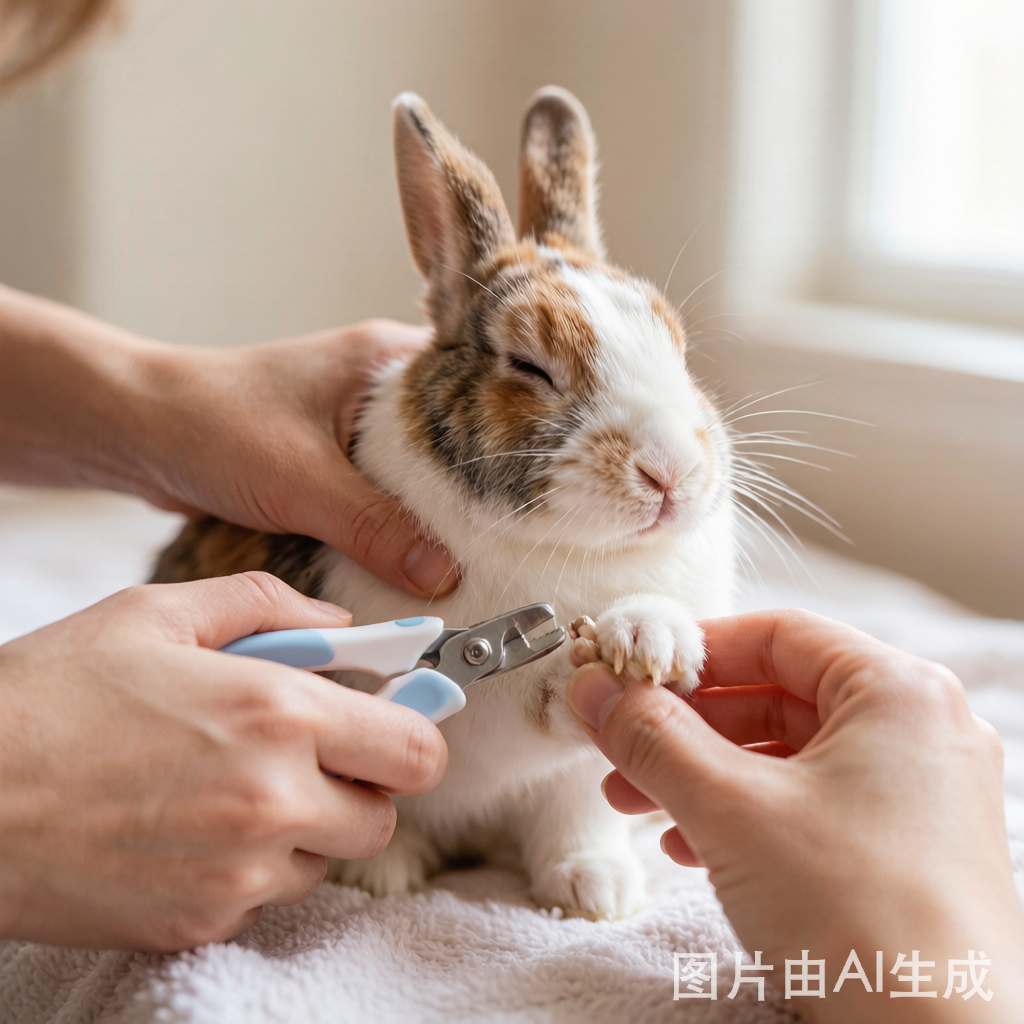
Trimming a rabbit’s nails is a two-person job the first several times you do it. One person restrains the rabbit securely but gently (more on technique below), and the other trims. Once you and your rabbit are both experienced, you may be able to do it solo, but there is no shame in asking for help.
Restraint technique:
Rabbits must never be placed on their back (the “trance” or tonic immobility position) for nail trims. This is not relaxation—it is a fear response. Instead, use the “bunny burrito” method:
- Wrap your rabbit snugly in a large towel, leaving only the head and one paw exposed at a time.
- Hold the rabbit against your body in a upright, seated position (the rabbit’s spine should be supported, not bent).
- Expose one paw at a time. Gently press the top of the paw to extend the nails.
The trimming process:
- Identify the quick. With light-colored nails, cut 2–3 mm in front of the pink area.
- With dark nails, cut in very small increments (1 mm at a time), looking at the cut surface after each snip. When you see a small dark dot in the center of the white cross-section, stop—you are approaching the quick.
- Cut at a slight angle that follows the natural curve of the nail.
- Reward your rabbit with a small treat after every 2–3 nails.
- Take breaks if your rabbit is struggling. A stressed rabbit is more likely to injure themselves or you.
What to Do If You Cut the Quick
Even experienced rabbit groomers nick the quick occasionally. It happens. What matters is how you respond. If you cut into the quick:
- Stay calm. Your rabbit will pick up on your energy. If you panic, they panic.
- Apply styptic powder immediately. Pinch a small amount onto the bleeding tip and hold for 30–60 seconds. If you don’t have styptic powder, cornstarch or flour works in an emergency.
- Apply gentle pressure with a clean cloth if bleeding continues.
- Monitor the nail for the next few hours. A small amount of residual bleeding is normal; continuous bleeding after 20 minutes requires a vet call.
Importantly, one bad experience doesn’t mean your rabbit will never tolerate nail trims again. Give them a few days to decompress, then restart with extra treats and perhaps a purring session (yes, rabbits purr when content) before the next attempt.
Age-Specific Nail Care
Kits and juveniles (under 6 months): Young rabbits are wiggly and their nails are tiny. Use extra-small clippers or even human infant nail clippers for kits under 12 weeks. Handle their paws frequently from a young age so they learn that paw-touching isn’t a threat.
Adults (6 months–7 years): This is the standard maintenance phase. Every 4–6 weeks, as described above. If you have a bonded pair, sometimes one rabbit will gently nibble the other’s nails, which can extend the time between trims—but don’t rely on this.
Seniors (7+ years): Older rabbits may have thickened, brittle, or curling nails. Arthritis can make restraint uncomfortable, so keep sessions short. Senior nails sometimes grow in a circular pattern (especially if the rabbit is sedentary), and these may need trimming every 3 weeks to prevent the nail from growing into the paw pad—a painful and infective condition.
Dewclaws: The Forgotten Nails
Many rabbits have a dewcaw on the inside of each front leg—a nail that doesn’t touch the ground and therefore never gets any natural wear. Dewclaws are notorious for growing in a complete circle and embedding into the leg if neglected. Check them every time you do a nail trim, and don’t forget them. They are often the longest nails on the rabbit.
When to Call a Professional
If you have tried and your rabbit becomes dangerously stressed, or if you simply cannot bring yourself to do it, that’s okay. Many rabbit owners rely on:
- Veterinary technicians — most small-animal vets will trim rabbit nails for a nominal fee (often $10–$20).
- Professional groomers — though not all groomers are comfortable with rabbits, those who list “small animal” or “exotic” grooming usually are.
- Rabbit rescue organizations — many offer low-cost nail-trimming clinics.
The only unacceptable option is not trimming at all. Overgrown nails are a quality-of-life issue that no responsible owner should ignore.
“I was terrified to trim my rabbit’s nails for the first year I had him. I took him to the vet every time. Finally, a tech showed me how to do it properly, and now it takes me 10 minutes at home. Don’t be afraid to ask your vet to demonstrate—most are happy to teach you.” — David L., rescued-lop owner.
Building a Positive Association
The best nail-trimming sessions are the ones your rabbit doesn’t dread. You can build positive associations by:
- Handling your rabbit’s paws every day during petting sessions, without clipping anything. Just touch, hold briefly, and reward.
- Using high-value treats (fresh basil, cilantro, tiny pieces of banana) that only come out during nail time.
- Keeping sessions short—three nails and a break is better than forcing all eighteen at once.
- Trimming after a meal when your rabbit is naturally calmer and more food-motivated.
With patience and consistency, many rabbits learn to tolerate—and a few even to accept—nail trims as a normal part of life. Your rabbit’s comfort, posture, and long-term joint health depend on it.